
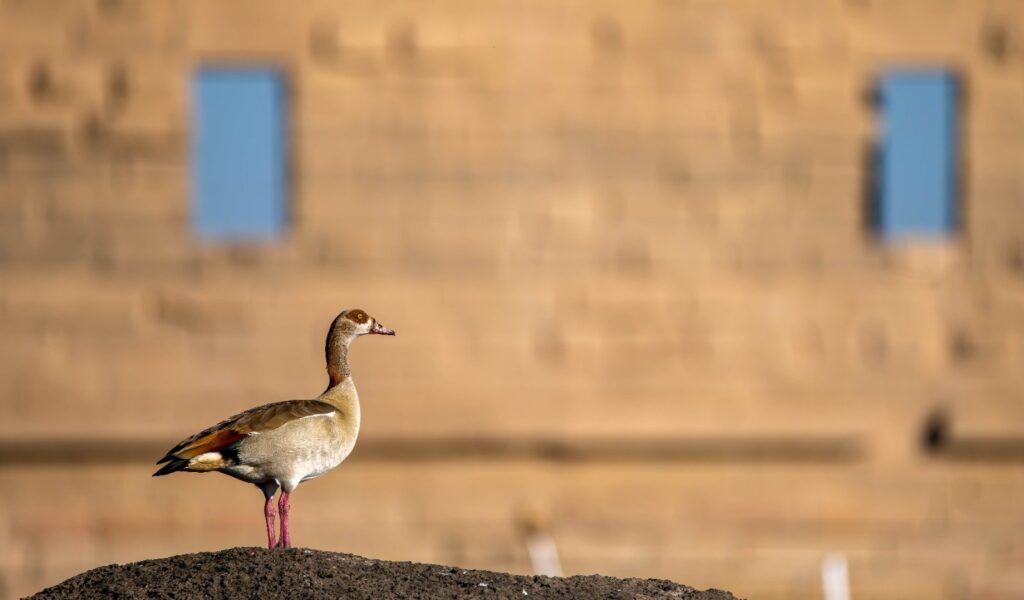
The Egyptian Goose maintains its vigilant post on the Nile’s verdant islets and along timeless riverbanks.
Its presence is both striking and enigmatic. Its figure blends the stature of a goose with the grace of a duck. Chestnut and cream feathers drape it in a mantle of elegance. At times, its sudden hisses and honks cut through the serenity of the waters.
Amid the grandeur of statues and temples, the Egyptian Goose in Aswan stands as a gentle reminder of its living treasures. A proud, fearless protector of ancient waters.
Egyptian Goose Profile
Key identification details for spotting the Egyptian Goose in Aswan:
| Field | Egyptian Goose |
|---|---|
| Scientific Name | Alopochen aegyptiaca |
| Identification | Duck-like goose with bold eye markings and upright posture |
| Size & Weight | Length: 25–29 in · Wingspan: up to ~5 ft · Weight: ~5–9 lb |
| Plumage | Greyish-brown body · Chestnut breast patch · White, dark brown, and iridescent green wings |
| Beak | Short, stout, pinkish |
| Legs & Feet | Long pink legs; strong feet adapted for land and water |
| Habitat | Freshwater rivers, lakes, wetlands, grassy riverbanks, parklands |
| Geographic Range | Africa (native); introduced in Europe, Asia, and North America |
| Movement | Resident (non-migratory) |
| Diet | Grasses, seeds, crops, insects, small amphibians |
| Social Behavior | Pairs or small flocks; highly territorial during breeding |
| Breeding Season | Typically July–March |
| Nest Type | Tree cavities, riverbanks, cliffs, buildings, or ground sites |
| Vocalization | Loud honks, hisses, snarling calls |
| Call Purpose | Alarm, territorial defense, pair communication |
| Lifespan | ~15 years (wild) · Up to 25 years (recorded) |
| Conservation Status | Least Concern (IUCN) |
A Portrait of the Egyptian Goose
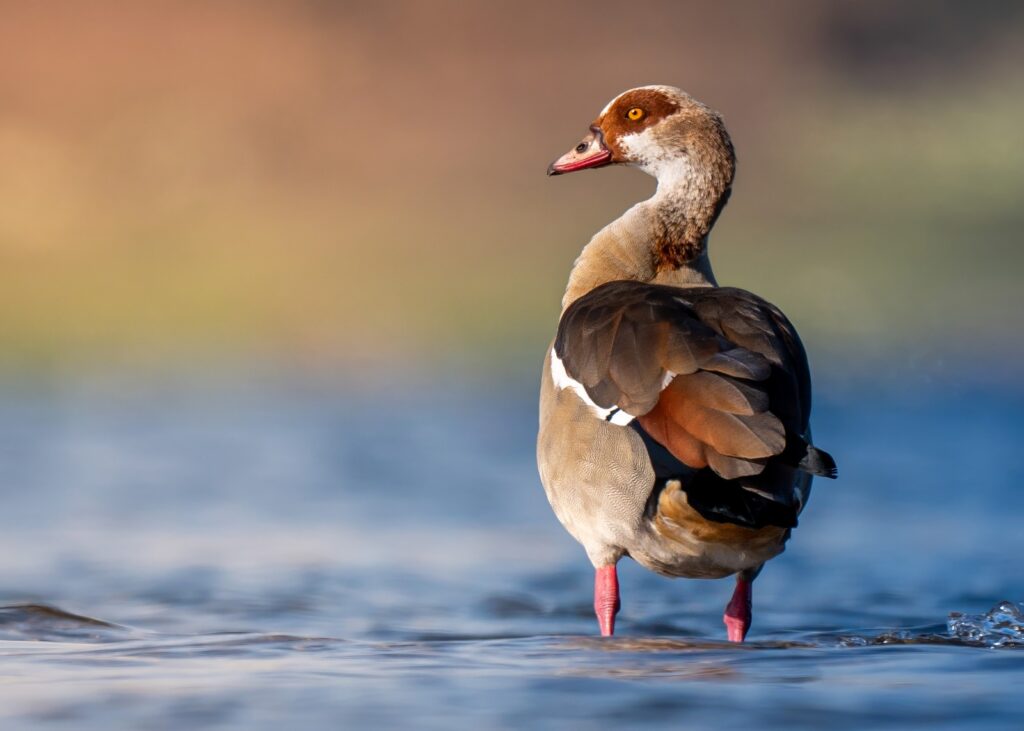
The Egyptian Goose (Alopochen aegyptiaca) is a medium-sized waterfowl. It’s neither quite goose nor duck, but something elegantly in between. Locals often call it the “Egyptian duck.”
It’s about 25–29 inches in length, with a wingspan stretching nearly five feet, and a weight of just over five pounds. This is the sheldgoose, smaller than most true geese, yet carrying itself with striking presence.
Its plumage is a study in captivating contrast. A gradient of greyish-brown flows from its back down to its chest, broken only by a distinctive brown patch on the breast. When the wings open, they reveal layered tones of brown and white, with a brief flash of emerald.
Framing its sunset-orange eyes are two dark brown rings that lend its gaze an intense, watchful quality.
Its long pinkish legs and a matching beak give it a poised, grounded stance along the Nile’s edge.
A Bold, Devoted Protector
The Egyptian Goose is a bird of conviction.
These birds mate for life and are most often seen in devoted pairs or protective flocks.
Their extended breeding season, from July through March, is marked by shared responsibility. Both parents are involved in guarding and incubating their eggs.
Once nesting begins, devotion turns resolute. Egyptian Geese are famously territorial, defending their chosen ground fearlessly. They’ve been reported to confront any foreign body, from rival birds and drones to low-flying planes, that encroach upon their domain.
Their vigilance is paired with notable intelligence. In a National Geographic documentary, an Egyptian Goose feigns injury to lure a leopard away from its vulnerable chicks.
When you see an Egyptian Goose in Aswan, approach with mindful respect. Listen for the sharp hisses and urgent honks that serve as clear, audible warnings that they perceive you as a threat.
From Sacred Symbol to Global Resident
Egyptian Geese are native to Africa, with their ancestral heartland in the Nile Valley and sub-Saharan regions.
The name “Egyptian Goose” is no historical accident. Ancient Egyptians domesticated and frequently depicted Egyptian Geese in tomb paintings and artifacts. They preserved the bird’s form alongside gods and royalty.
The bird is also as resilient as the civilization that revered it. Introduced populations now thrive far beyond their native range, establishing themselves across Europe (the UK, the Netherlands, Germany, and Belgium). You’ll also spot them in scattered parts of North America, from Texas to Florida.
This global success is a testament to their remarkable adaptability. While they prefer the lush margins of freshwater lakes, rivers, and parkland wetlands, they readily nest further inland.
Their diet is equally versatile, foraging on land for grasses and seeds, small insects, and even the occasional frog.
Spotting the Egyptian Goose in Aswan
You can enjoy sightings of the Egyptian Goose in Aswan year-round. It’s a permanent resident that rarely migrates.
However, to ensure a comfortable and active encounter for both observer and bird, it’s best to schedule viewings outside the peak summer heat.
The Egyptian Goose is most visible early morning and late afternoon, feeding and moving along the water’s edge. In the peak heat of the day, activity slows as the bird withdraws into shade.
You can easily spot the Egyptian Goose in Aswan:
- Along the lush Nile banks
- Across the scattered grassy islets
- On historic islands such as Sehel
- Look out for their distinctive honks
Tarot Tours Tip: A felucca ride offers an ideal vantage point, letting you observe these birds in motion against the river’s gentle flow.
To witness the elegance of the Egyptian Goose in Aswan firsthand, explore our curated Aswan itineraries.