In a country with more than 5,000 years of ongoing history, a tour is never only about the destination.
Conversations drift between past and present simply because one grows out of the other; the two are inseparable. And not every guest question has a comfortable answer; the best guides know that.
On our recent Philae Temple tour, we took notes on how this complexity is handled.
We saw how it all connects in a traveler’s mind: how a temple built around a love story between goddess Isis and god of the deceased Osiris opens into conversations about modern marriage economics.
Here’s what we noticed.
On the Way to Philae: Marriage, Tradition, and a Changing Economy
On the bus, in the busy Egyptian streets, there’s always something that triggers a question from a guest or an insight from a guide, even before a tour starts.
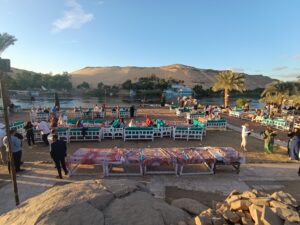
That time, it was a classic Egyptian street wedding. Along the corniche in Aswan, wedding celebrations often spill onto the riverbank beside the Nile cruise ships.
The next morning, guests are curious about what they witnessed. Who pays for a wedding in Egypt? How come the bride had so much jewelry? How long does it take a couple to save? Has any of this changed?
A guide like Tamer Tatou, another one of Tarot Tours’ longest-standing tour guides in Egypt, treats these as some of the most natural questions of the day.
He’ll explain that in Ancient Egypt, the world of Isis and Osiris, the groom paid the bride’s family directly and was expected to provide the home. This custom was later reinforced by Islamic tradition that still shapes expectations today.
Then he’ll fast-forward the conversation. Rising costs and economic pressures in Egypt have changed what couples can realistically take on. The shabka (“bride’s jewelry”) is often negotiated. Furnishing an apartment is now commonly split between families. Upper Egypt, he might add, tends to hold on to older customs longer than Cairo does.
Guests receive their answers: history first, then the present, offered without judgment either way. The questions branch from there: religion, family, housing, whether people still marry young.
Some get a full answer. Others get a shorter one, leaving space for guests to compare it with their own experiences and draw their own conclusions.
The Felucca to Philae Temple: When History Thickens
The Nile felucca ride toward Agilika Island is where the conversation often deepens.
A pair of Egyptian geese skims low across the water, a motif painted on temple walls still holding its place in the ancient city. Meanwhile, small granite islands rise out of the Nile, remnants of a landscape reshaped twice: first by the old Aswan Dam in 1902, then by the High Dam decades later.
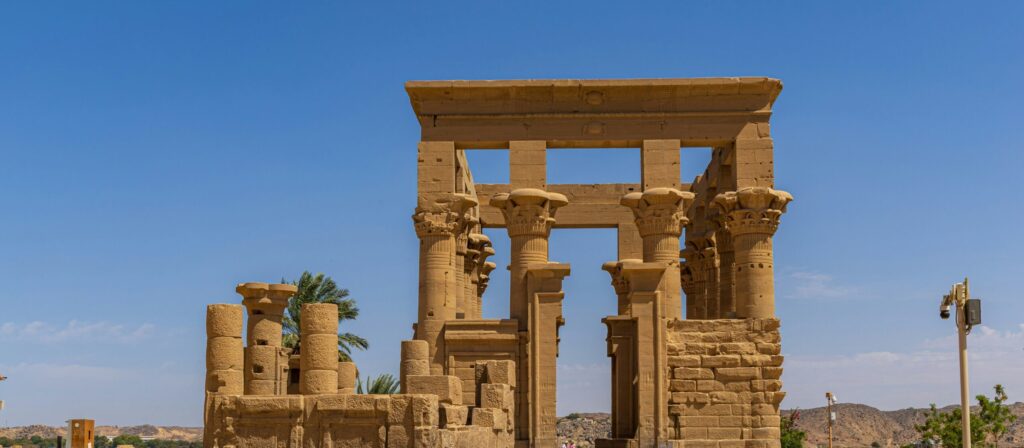
Philae itself was a casualty of that second change. The original temple complex, once on a different island entirely, was dismantled stone by stone and rebuilt on higher ground. This revival is described as one of UNESCO’s most ambitious rescue projects in Egypt.
It’s a remarkable story on its own. But guests often ask the next question anyway: what happened to the people who lived on those islands?
Tatou answers carefully. Some families were displaced. Some sadly chose to be swept away by the water with their homes.
For Nubian communities, this wasn’t only a logistical disruption. It was the erasure of villages, cemeteries, and a continuous way of life that had existed alongside the Nile for millennia.
The bitterness is still present and openly discussed in Nubian neighborhoods in Aswan today. Tatou doesn’t soften this or rush past it. He names it, gives it its weight, and lets guests sit with it before the conversation moves on.

The Philae Temple Tour: Understanding Egypt in Layers
By the time the group steps onto Agilika Island, the temple reflects everything discussed on the way there.
Philae’s first hall belongs to Isis: her search for Osiris, his resurrection, the birth of Horus, told almost like the life story of a relative.
Deeper in, Ptolemaic columns give way to Roman additions, each ruler building onto what came before rather than erasing it. Further still, Coptic crosses are carved into older stone, a sanctuary repurposed as a church, reliefs softened where one faith’s imagery met another’s.
Three religions, one set of walls, each leaving its own mark on the structure.
The meaning is clear: Egypt’s past doesn’t move in straight lines. It accumulates rather than replaces.
The conversations from the bus and the felucca, about tradition meeting modern pressure and communities adapting without disappearing, feel reflected here in stone.
Guests take this in differently. Some linger by a column. Some wander toward the windows facing the Nile. Some stay close to Tatou, seeking more answers.
What Guests Remember from the Philae Temple Tour
The ride back from Philae Temple is often quieter than the ride there, but rarely because the conversation has stopped.
More often, it continues in fragments. Questions that began on the bus return in different forms. Marriage traditions, displacement, and the temple’s relocation are connected again in passing.
What stays with guests usually isn’t a single fact about Philae. It’s a broader sense of Egypt. Where ancient history and modern life sit alongside each other, not as separate stories, but as part of the same landscape.
For operators placing high-expectation travelers in Egypt, that range of conversation is the product. The temple is context.
Book our next Philae Temple tour or explore our Egypt itineraries for your 2026/27 journeys.
Tarot Tours Tips for Your Philae Temple Tour
- Philae Temple is reachable only by boat from the Philae Marina south of Aswan; transfers run as one coordinated flow (pickup → drive → boat → site entry).
- The bus ride from Aswan Port to Philae Marina takes ~20 minutes.
- The boat ride to and from Philae Temple takes ~15 minutes.
- Total time of a Philae Temple tour, including transfers, boat ride, and guided visit: roughly 3–4 hours.
- Often paired with the Aswan High Dam as a half-day itinerary, or scheduled standalone within a Nile cruise day.
- Morning departures (especially Nov–Feb) are preferred for cooler temperatures and smoother marina conditions.
- Best positioned as a reflective midpoint in Upper Egypt itineraries rather than a headline stop, leaving room for the river journey and storytelling.